Publish Date
March 2026
What Whisky Should I Try Next? A Guide to Finding Your Taste

Tyler Berry
Whisky Collector
You've tried a few whiskies. Some you liked, some you didn't, and one or two were genuinely special. Now you want to find more of whatever that special thing was. But standing in front of a wall of 200 bottles, or scrolling through a retailer's website, the options are overwhelming.
The good news is you already have the most useful tool for finding your next whisky: your own experience. You just need a way to make sense of it.
Start with what you already know you like
Take the last three whiskies you genuinely enjoyed. Not the ones that were fine. The ones you'd buy again without hesitating. Write them down and look at what they have in common.
Are they all from the same region? All the same type? Similar age? Similar price point? You might notice patterns you weren't aware of. Maybe all three are sherried Speysides. Maybe they're all bourbon-cask Highland malts. Maybe they're all over 46% ABV.
These patterns are the start of your taste profile, even if you haven't formalised it yet.
Use flavour, not brand
The most common mistake when looking for your next bottle is searching by brand or distillery. "I liked Glenfiddich 12, so I'll try Glenfiddich 15." That's not a bad approach, but it's limiting. You're only exploring one distillery's range when there might be dozens of bottles from other producers that match what you enjoyed about the first one.
A better approach is to think about flavour. What specifically did you like? Was it the sweetness? The smokiness? The fruit? The spice? If you can name even one or two flavour characteristics, you can search for other whiskies that share them.
This is harder to do on a retailer's website, where search is usually by name, price, or region. But it's exactly what a flavour-based recommendation system is designed for: give it the flavours you enjoy, and it finds bottles that match.
The exploration method
If you want to systematically expand your taste, try this approach.
Pick one dimension and change it. If you love Speyside single malts, try a Highland single malt. Same type, different region. See what changes. If you love unpeated whiskies, try a lightly peated one. Not Laphroaig (that's jumping in at the deep end), but something like Highland Park or Talisker where the peat is present but not dominant.
Change one thing at a time. If you change the type, region, and age all at once, you won't know what made the difference when you like or dislike the result. Controlled exploration teaches you more than random exploration.
Keep notes. Even brief ones. "Liked the sweetness but the finish was too short" or "more smoke than I expected, but I didn't hate it." These observations accumulate into genuine self-knowledge about your palate.
Ask other collectors

One of the best recommendation engines is a person who knows what you like. If you've got friends who drink whisky, tell them what you've enjoyed and ask what they'd suggest. People who know your taste can make connections that algorithms can't.
This also works in reverse. If someone whose palate you trust recommends something, try it even if it's not what you'd normally pick. Some of the best discoveries come from stepping outside your usual pattern because someone you trust nudged you there.
Online communities can serve the same function. Whisky forums, subreddits, and collector platforms all have people who enjoy making recommendations. Share what you've liked and you'll usually get thoughtful suggestions.
Don't chase scores
A bottle rated 92/100 by a reviewer might be a 70 for you. Scores reflect someone else's palate, not yours. They're useful as a rough quality filter (a whisky with a community average of 85+ is probably well-made) but they shouldn't override your own preferences.
If you consistently enjoy whiskies that score in the 70s because they happen to match your flavour preferences, that's not a failure of taste. That's self-knowledge. The whisky world has a habit of telling people what they should enjoy. Ignore that. Drink what you like.
The sample shortcut
If you're hesitant about spending £50 or more on a bottle you might not enjoy, look for samples. Many specialist retailers sell 3cl or 5cl samples of their range. Some sell tasting sets grouped by region or style.
Samples let you try before you commit. Three or four samples for the price of one bottle gives you a much better sense of what direction your next full purchase should go. It's the most cost-effective way to explore.
Build your taste profile over time
The most reliable way to find whiskies you'll love is to build a record of what you've already tried and how you felt about it. Not just "liked it" or "didn't like it," but what specifically you noticed.
Over time, this becomes a profile. You start to see that you consistently gravitate toward dried fruit and spice, or that you score peated whiskies lower, or that cask strength expressions always do well with you. Once you have that picture, finding your next bottle becomes much easier because you know what you're looking for.
Cabinet builds this for you
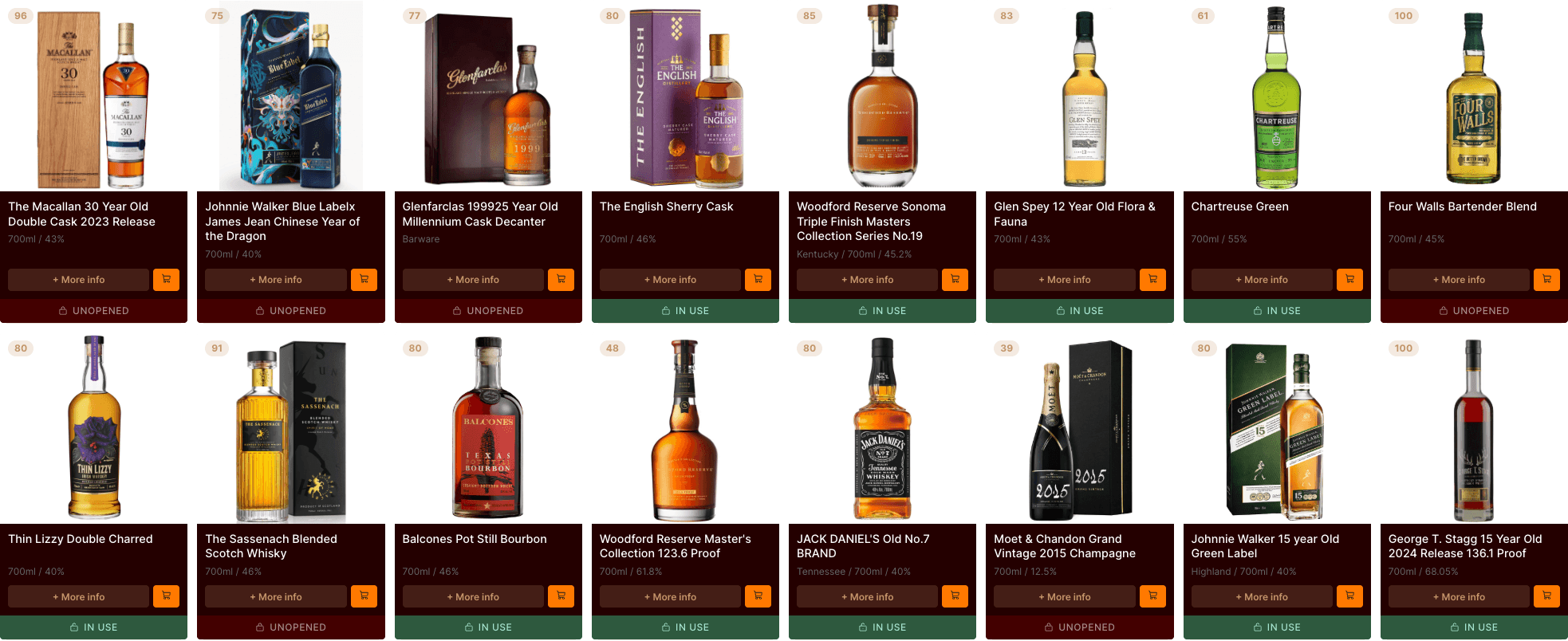
Cabinet's taste profile tracks your preferences automatically. Rate bottles, tag flavours, and over time your personal radar chart emerges across eight flavour dimensions. Cabinet then recommends bottles whose flavour profiles match yours, with match confidence percentages so you can see how well each suggestion fits.
It's not based on what's popular or what's being promoted. It's based on what you actually enjoy.
Find out what kind of whisky drinker you are. It's free.