Publish Date
March 2026
How to Organise Your Home Bar

Tyler Berry
Whisky Collector

A good home bar is one you actually use. And the difference between a bar you use and a bar you just look at usually comes down to organisation. When you know what you've got, you pour with confidence. When you don't, you default to the same three bottles every time.
Whether your home bar is a dedicated room, a drinks cabinet, a shelf in the kitchen, or a tray on a sideboard, the principles are the same.
Separate the drinkers from the display
Not every bottle is there to be drunk. Some are for special occasions. Some are investments. Some are just beautiful objects you enjoy having on show.
Be honest about which bottles fall into which category, and organise accordingly. Your everyday pours should be front and centre, easy to reach, easy to see. The bottles you're saving can sit further back, higher up, or in a separate area entirely.
This sounds obvious, but most home bars mix everything together. The result is that you reach past a £200 bottle every time you want a Tuesday evening dram, and the everyday bottles get lost behind the special ones.
Group by what makes sense to you
Some people organise by spirit type: whisky, gin, rum, tequila, each in their own area. Some organise by occasion: everyday pours, cocktail ingredients, sipping spirits. Some organise by frequency: the bottles you reach for weekly at the front, the ones you open twice a year at the back.
There's no wrong answer. The point is having a system at all. Even a rough grouping is better than a random arrangement where you have to scan every label to find what you want.
Know what you've got
The most common problem with a home bar isn't organisation. It's knowledge. You forget what's there. You buy duplicates. You don't realise something is nearly empty until you go to pour it.
A simple inventory fixes this. It doesn't need to be exhaustive. Just a list of what's on your bar, whether it's open, and roughly how full it is. Update it when you buy something new or finish something old.

You can do this on paper, in a spreadsheet, or in an app. The method matters less than the habit. If you know what you've got, you make better decisions about what to buy next, what to pour tonight, and whether you really need that bottle you've been eyeing online.
The "what should I pour?" problem
This is the real reason most people want to organise their home bar. Not for the aesthetics (though that's a bonus), but because they stand in front of 20 bottles and can't decide what to drink.
Organisation helps here because it reduces the decision space. If your open bottles are separated from your sealed ones, you're already only choosing from the bottles that are ready to drink. If those are grouped by type, you can narrow it further: "I'm in the mood for something smoky" points you to one section of the shelf.
And if you really can't decide, there's always the coin flip approach. Or you could let an app pick for you.
Keep it maintained
The best-organised home bar in the world falls apart if you don't maintain it. Every new bottle goes in its spot. Every finished bottle comes off the shelf. Every few months, have a quick look at what's been sitting untouched and ask yourself why.
A bar that's actively maintained is a bar you enjoy using. A bar that's been left to accumulate becomes a source of mild guilt. Don't let it get to the guilt stage.
Cabinet can help
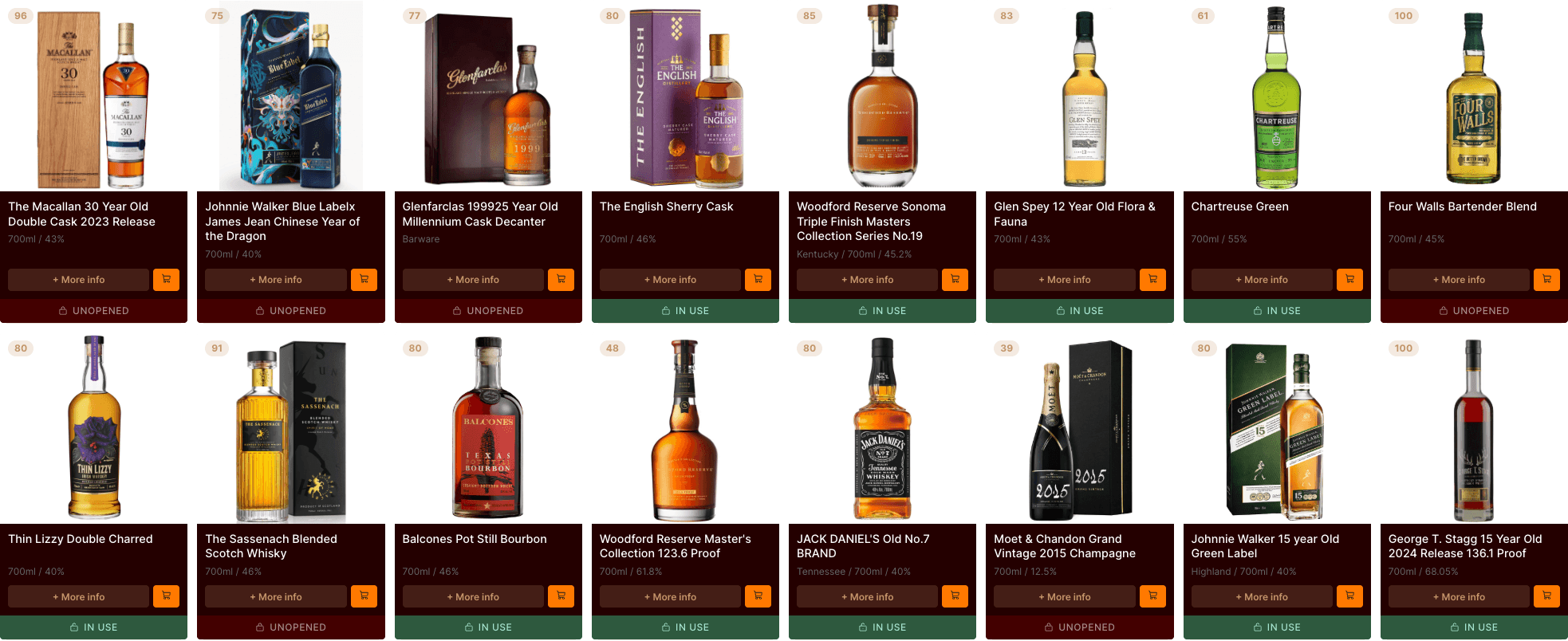
Cabinet tracks your entire home bar digitally. Every bottle, every level, every location. Scan a barcode to add new bottles. Track what's open, what's sealed, and what's running low. Tag bottles by location if you've got spirits in more than one room or house.
The Pick My Pour feature even solves the "what should I drink tonight?" problem. It picks a random bottle from your open collection so you don't have to choose.
Start organising your home bar. It's free.