Publish Date
March 2026
How to Insure Your Whisky Collection

Tyler Berry
Whisky Collector

If your house flooded tomorrow, could you tell your insurer exactly what was on your whisky shelf?
Most collectors can't. They know roughly what they own and have a vague sense of what it's worth, but the detail an insurance claim requires, bottle names, purchase prices, dates, estimated current values, is scattered across receipts, emails, and memory.
This is fixable. And you don't need to wait until something goes wrong to sort it out.
Does your home insurance even cover it?
Standard home contents insurance covers your belongings up to a certain value per item, typically between £1,000 and £1,500 for a single item depending on your policy. If none of your bottles individually exceed that threshold, your collection may already be covered under your general contents.
But there are catches. Many policies have a total limit for collections or "high-value items in aggregate." If your shelf is worth £5,000 across 40 bottles, your policy might only cover £2,000 of that unless you've declared the collection specifically.
The only way to know is to check. Read your policy or call your insurer and ask two questions: what's the single-item limit, and is there an aggregate cap on collections? If your collection exceeds either threshold, you'll need to declare it as a specified item or add a personal articles rider.
What your insurer will want to see
If you're declaring your collection or making a claim, your insurer will expect documentation. The more detail you can provide, the smoother the process.
At minimum, they'll want a list of bottles with names, approximate values, and ideally purchase receipts. A comprehensive inventory goes further: distillery, type, age, ABV, purchase price, purchase date, retailer, estimated current retail value, and photos.
That sounds like a lot of work if you're starting from scratch. If you're already tracking your collection digitally, it's a five-minute export.
Purchase price vs current value
Insurance typically works on one of two bases: agreed value or market value. Agreed value is set at the time you declare the item and stays fixed until you update it. Market value reflects what it would cost to replace the bottle today.
For most collectors, purchase price is the starting point. But whisky can appreciate significantly after release. A bottle you bought for £60 might cost £150 to replace a year later. If your policy is based on agreed value and you declared it at £60, that's all you'll get back.
This is why keeping your valuations current matters. Review your collection's estimated value at least once a year and update your insurer if it's changed materially. Some collectors do this every six months, particularly if they hold limited releases or allocated stock that appreciates quickly.
How to build your inventory

You have a few options.
Spreadsheet. The old-fashioned way. Create columns for name, distillery, type, purchase price, purchase date, estimated current value, and notes. Add photos if you can. It works, but it's manual, and keeping it updated takes discipline.
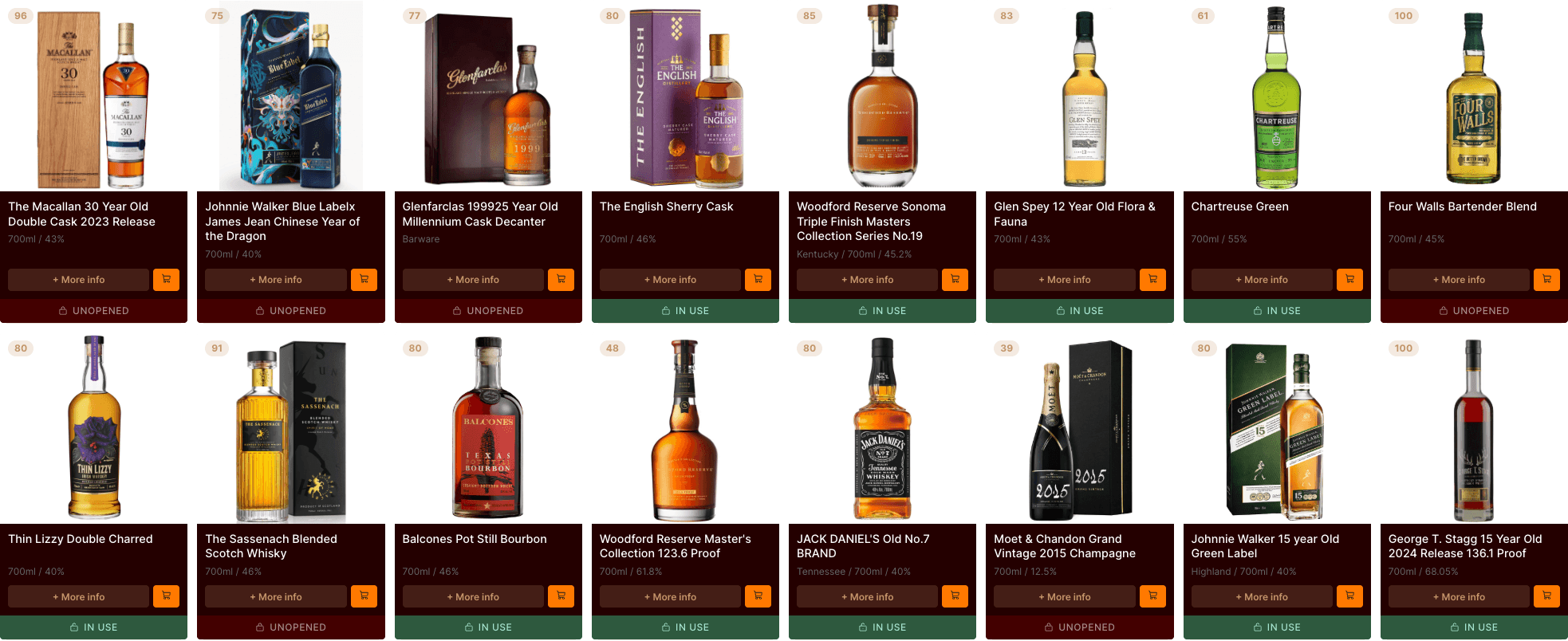
Dedicated app. A collection tracker handles the structure for you. Add your bottles (by barcode scan or manual entry), fill in purchase prices and dates, and the app maintains your inventory. When you need to send it to your insurer, export the data.
Photos. At the very least, photograph every bottle on your shelf, including the label and any packaging. If you can't prove you owned it, an insurer may dispute the claim. Photos timestamped on your phone are basic but useful evidence.
The best approach is a combination. Track your collection in an app for the structured data, and keep photos as a backup.
Keep your receipts
Email confirmations from online retailers are your best friend. Most specialist whisky retailers send detailed order confirmations with bottle names, prices, and dates. Don't delete them. Create an email folder or label for whisky purchases so they're easy to find.
If you buy in person, photograph the receipt before it fades. Thermal paper receipts become unreadable within months.
What to do right now
If you've been putting this off, here's a ten-minute version.
Take photos of your entire shelf, front labels visible. Open your email and search for order confirmations from the retailers you buy from. Make a rough list of what you own and what you paid. Check your home insurance policy for the single-item limit and collection cap.
That gets you 80% of the way there. The rest, building a proper bottle-by-bottle inventory with current values, is easier if you use a tool designed for it.
Cabinet can help
Cabinet tracks every bottle in your collection with purchase prices, dates, distillery details, and photos. The collection value feature shows your total at a glance and tracks how it changes over time.
When you need documentation for your insurer, Cabinet generates a PDF report of your entire collection: every bottle, every price, every photo. It's the inventory your insurer wants, produced in seconds instead of hours.
Track your collection value with Cabinet. It's free.